
 Back to all articles
Blogs
The 2026 DevOps Implementation Guide: Strategies, Roadmap, and Best Practices
 By Nextbridge Editorial Team
O
nce considered “nice to have”, the DevOps process is no longer an option, but mandatory for all organisations. The difference is obvious. Companies with DevOps maturity move faster, while those without lag behind. Here’s a surprising fact: Many companies claim to implement DevOps, but only a few mature successfully.
In the US market, there is no room for slow processes. Its precision and speed define the winners. To be a part of the competition in such a market, you cannot afford to slow down.
So, you need something more than great ideas: DevOps, which turns complexity into momentum. This is how all the modern businesses in the USA stay sharp, responsive, and ahead, giving them a competitive advantage they need to lead, not follow.
Want DevOps maturity in 2026 and onwards? Implement the right strategies, roadmap, and best practices. Let this blog lead you. But first, understand what modern DevOps is all about.
Clarity on Modern DevOps
Modern DevOps goes beyond the integration of development (Dev) and IT operations (Ops). It is more than just speeding up the product delivery. It extends through collaboration, automation, and continuous improvement across the entire software lifecycle. It ensures products evolve with reliability and precision through these practices:
- DevSecOps for built-in security
- A/B testing
- Performance feedback loops
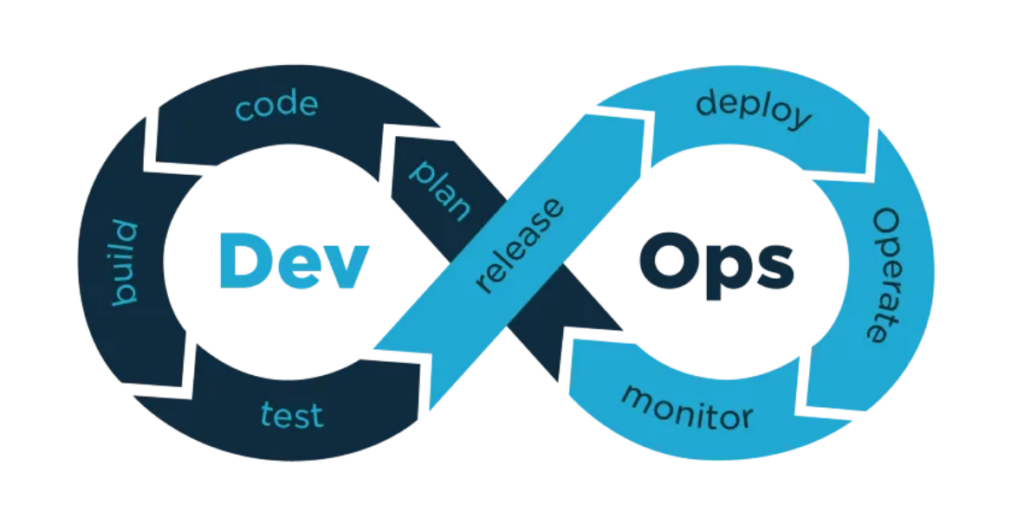
Talking about modern DevOps in practice, CI/CD and automated testing keep the code solid, cut down errors, and eventually speed up delivery. Moreover, it empowers teams to collaborate better, automate smarter, secure continuously, and deliver software that has perfect alignment with business goals and user needs; reliable and faster than ever before.
Business Value of DevOps
Implementing the DevOps process without knowing what value it brings to your business is like running in circles. So, here is the beginning of your DevOps journey.
A clear DevOps roadmap helps companies turn speed into a competitive advantage. They overcome delays in product delivery while responding to customer demands and market shifts quickly. With faster launches come strong competitiveness and measurable business advantages.
Speed, adaptability, responsiveness, and market dominance. DevOps delivers all by:
- Reducing time to market: Faster deployment enables adaptation to market demands instantly.
- Using resources more efficiently: Automation and optimising infrastructure deliver faster results with lower costs.
- Improving customer experience: Stable, high-quality systems bring happier and more satisfied customers.
Core DevOps Principles
Before jumping to DevOps strategies, have a look at the core principles DevOps is built on.
No strict rules. DevOps believes in some general principles that lead towards a successful process at each stage: culture, automation, measurement, and responsibility. Let’s dig into how these fundamental DevOps principles make a connection between Dev and Ops stronger and more effective.
- Teamwork and Communication
DevOps breaks down silos; promotes constant communication and collaboration between teams. Every member is accountable for timely delivery and stability. The effect: smoother and faster workflows with motivated, high-performing teams.
- Automated Systems and Continuous Process
DevOps automation replaces manual processes and pipelines with processes like CI/CD and IaC; automation of scripts and infrastructure. Automated environments improve delivery speed, consistency, and freedom. It frees teams from repetitive tasks, allowing them to focus on delivering the real business impact.
- Continuous Feedback and Growth
Each environment update or release brings along metrics, logs, and user feedback. It flows directly into the next sprint, improving the DevOps pipeline. This approach keeps solutions always in motion and constantly enhancing to fit the users' needs and latest technological innovations.
- Shared Responsibility and Ownership
You are already aware of the fact that the DevOps business model keeps the development and operations team in the loop, from start to end, throughout the software development lifecycle. This ensures engagement of all team members in the development, deployment, and maintenance phases. Everyone enjoys a sense of ownership over the project in each phase.
DevOps Strategies for Reliable Software Development
We have mentioned it multiple times already. Recall once again: Implementing the right DevOps strategies speeds up the software development process, helping businesses:
- Quickly respond to market trends
- Meet the expected quality standards
- Outperform competitors
Want this with a fast, reliable, and smooth software development process? Let’s explore proven DevOps strategies that make it happen.
- Continuous Implementation and Continuous Delivery (CI/CD)
CI/CD is a fundamental practice in the DevOps transformation plan. CI integrates code from multiple developers into a central hub. This is how you can catch and fix integration errors earlier in the software development cycle. CI pipeline automation strengthens the process of code integration and validation. The outcome? The code moves from development to testing in far less time. Jenkins, Gitlab, CircleCI, and TeamCity are some of the top CI tools.
Implement a CD that takes it further with automation of code deployment to multiple environments, including production. It builds, tests, and deploys applications automatically, so they are always deployment-ready. With this approach, you can cut down the time and effort required for releasing new features or fixing bugs. The real benefits come in the form of faster, reliable software delivery. Tools that make it all happen are Jenkins, Nagios, JMeter, SonarQube, AWS CloudFormation, and Bamboo.
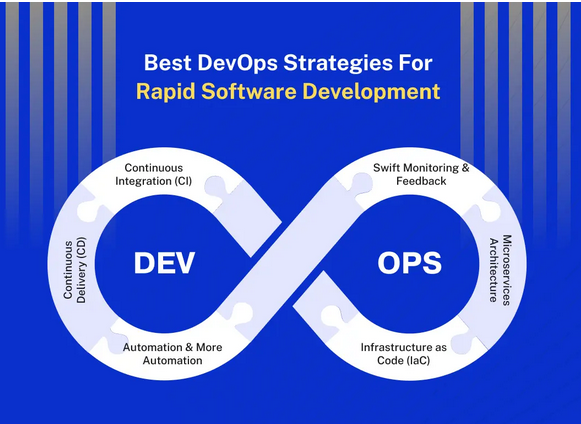
- Infrastructure as Code (IaC)
With IaC, you can write, manage and treat infrastructure configurations as code. It
helps you create and manage environments faster, reduce manual efforts, maintain consistency, and reduce mistakes. Still wondering how to make it happen? Use tools like CloudFormation, Ansible, Chef, Terraform, Pulumi, Chef, and OpenStackHeat.
- Automation and More Automation
Automation is the heart of everything in DevOps. It does not stop at CI/CD or IaC. Testing, monitoring, security, and incident response; You name anything, and it is automated. So, automate everything witnessing:
- Tests run faster
- Issues show up sooner
- Performance issues spotted in real time.
Lead this change with the automation tools like Amazon CloudFormation, Terraform, Ansible, Puppet, and Kubernetes.
- MicroServices Architecture
Time to say goodbye to monolithic applications by breaking them into smaller and independent services. This is what microservices architecture does. Develop, test, and deploy these services to promote flexibility and parallel development.
- Rapid Monitoring and Response
Monitor, fix, repeat. That’s all, and your team can get real-time insights instantly, make quick fixes, ensure smarter decisions and witness smoother releases. How to do that? Using tools like AppDynamics, ELK Stack, New Relic, Grafana, Sensu, Raygun and DataDog.
30-60–90 DevOps Strategy Roadmap
Big names like Amazon and Netflix are leading because of DevOps. It lets them push updates quickly and confidently. Follow this comprehensive 90-day roadmap to start building, testing, and deploying like a real DevOps pro.
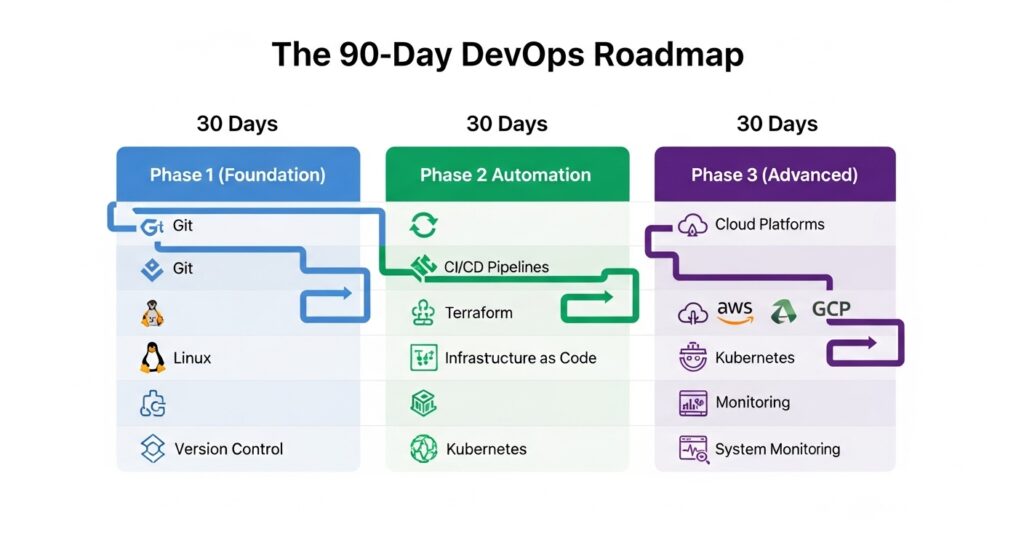
Phase 1: Building Foundation (1-30 Days)
Build your base and have a grip on essentials:
- DevOps principles and culture
- Core networking for DevOps
- Git and version control
- Linux and shell scripting
Phase 2: CI/CD and Process Automation (31-60 Days)
Automate fast and deliver faster with the following:
- CI/CD pipelines (Jenkins, GitHub Actions)
- Infrastructure as Code (IaC) with Terraform
- Deploying applications with Kubernetes
- Containers: Docker & Kubernetes
Phase 3: Advanced DevOps and Cloud Formation (61-90 Days)
Prepare the cloud and get ready for production.
- Basics of Cloud Computing (AWS, Azure, GCP)
- Monitoring and Logging
- DevOps security and best practices
- Creating a complete DevOps pipeline
DevOps Best Practices
Want to achieve true DevOps? It relies on standards, automation, and cross-team collaboration, keeping all pipeline phases efficient and stable. Implement these five DevOps best practices to ensure predictable results:
- Shift-Left Security
Start security in DevOps from the first day. Embed back-to-back checks during the initial design stages for code scanning and patch verification. Both are core to DevOps security automation. During integration, it catches vulnerabilities before they get out of hand and improves DevOps information security. Avoid last-minute compliance headaches and be certain about reliable and smooth systems with this approach.
- Log and Monitor Comprehensively
Track logs, metrics, and user feedback in real-time. Make smarter, faster decisions. Experience instant triggering of alerts in case of inconsistencies, which allows teams to fix issues immediately. Combine DevOps and DecSecOps principles with this approach. Ensure full visibility combined with operational reliability under live loads.
- Make Small, Frequent Releases
Never wait to fix the problems in a large project that has already been released. Make problems easier to fix and reduce risk with regular, small updates. This practice encourages users to stay content with constant changes instead of waiting for too long.
- Use Agile-DevOps Combination
Agile manages sprint-based user stories, but DevOps pipelines deal with the creation of a fast environment and continuous integration. Integrate both agile and DevOps to let teams handle recurring backlogs and automated release cycles. From planning to implementation, provide clear processes through integration.
- Document IaC
Treat environment definitions as your code. Track them exactly like your dev code, for example, Terraform scripts. This way, it is easier for you to roll back or replicate in case something goes wrong. Repeatable and auditable environments are key to helping
Your Path to DevOps Maturity
DevOps maturity is not a finish line. It is an ongoing pattern that shows at what point your organisation stands in its DevOps journey. Moreover, it specifies what more you need to reach the expected outcomes. You have already understood how the implementation of the modern DevOps process impacts culture, automation, security, and collaboration. The next step is to understand that it is a continuous journey, and not a final destination.
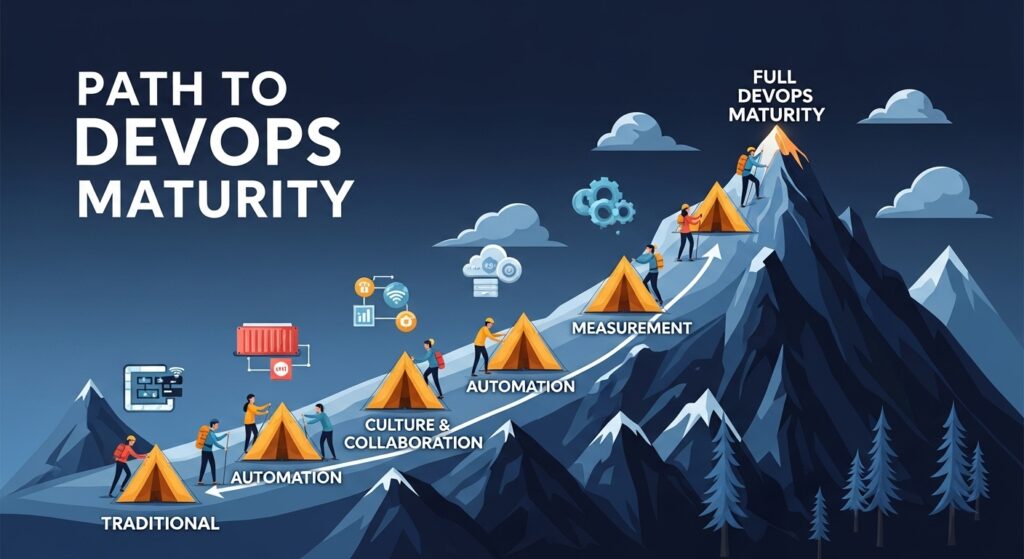
Understanding DevOps maturity includes:
- Evaluating the modern state of skills
- Identifying growth measures
- Mapping out steps to reach the required DevOps goals
With these levels in mind, you can improve the way you develop, deploy and test in all layers of DevOps: application, data, and infrastructure.
Finding The Right DevOps Talent
All the DevOps knowledge is not going to help you if you cannot hire the right team. By hiring, we do not mean just filling the empty seats; we mean a passionate team that works with energy, collaboration, and innovation.
The ideal DevOps candidate possesses a blend of technical expertise, interpersonal skills, effective cross-functional communication, and management of the entire DevOps pipeline. No matter if you are offering on-site roles or remote DevOps positions, look for only those professionals who are well aware of problem-solving and understand new technologies.
Before hiring them, conduct performance testing and training with DevOps concepts to ensure you are going in the right direction while finding the relevant talent. Winning organisations start by hiring with purpose and build a culture of transparency and continuous improvement.
Top talent just does not show up. You attract it with the right magnet: strategy, visibility, and a brand candidates would love to be a part of. Be open to using multiple sourcing channels, including internal talent, job boards, social media, referrals and partnerships with educational institutes. Be clear while defining requirements for DevOps engineer jobs, create a smooth experience for the candidates, and conduct fair interviews. All of this is a part of the right approach to attract professionals who bring innovation, create strong pipelines and help your business compete in the market.
Scaling DevOps to Secure Future
Built on the importance of maturity and best practices in the DevOps implementation, there is a task force that helps businesses like yours in the USA: Nextbridge. With expert DevOps implementation services, the team is designed to strengthen your software delivery and operation workflows. With a focus on scaling DevOps, all the team members are experienced to expand your pipelines efficiently, while maintaining speed and reliability. Each member holds DevOps certifications to ensure best practices are followed.
Not sure where your DevOps slows down? Is it an AWS DevOps pipeline? Or Azure DevOps pipeline? Want a clear DevOps transformation roadmap? Engage with a DevOps consultant from Nextbridge to get clarity on pipeline optimisation, automation and security integration. Be another success story with a DevOps expert consulting by improving collaboration, reducing release time and strengthening infrastructure.
Conclusion
Here is the simple truth: businesses win when their systems are fast, stable and scale without resistance. That’s exactly what a well-implemented DevOps process offers. It moves software delivery from a slow and reactive cycle to a powerful hub of automation, collaboration, and ongoing improvement. But you cannot win with just DevOps tools alone. You need a direction. You need a roadmap. This is how it becomes your competitive weapon: tuned pipelines, workflow automation, cloud-ready architecture, and reliability.
Even then, if you are not sure how to implement DevOps, pair up with a DevOps strategy consulting expert. Raise the bar in DevOps as a service.
Begin your DevOps journey.
FAQs
What is the difference between DevOps and the modern DevOps system?
A DevOps framework unites practices and culture to combine development and operations. On the other hand, the modern DevOps framework extends it with continuous improvement throughout the entire software lifecycle. Moreover, the modern framework integrates advanced tools for security, monitoring and managing complex systems beyond CI/CD.
How can DevOps consulting benefit my business?
DevOps consulting directs organisations to implement strategies, optimise pipelines, and enhance team collaboration for observable business growth.
What is the role of DevOps consultancy in achieving DevOps maturity?
With DevOps consultancy, you are able to assess your current state, design a clear road map, and implement the best practices. With this approach, you can improve your DevOps culture, automation, and monitoring process, leading you towards maturity.
What does DevOps as a Service really mean?
DevOps as a service provides an expert team that eliminates the need for an in-house team for:
- Managing CI/CD
- Automation
- Monitoring and security
Don't hire us right away
talk to our experts first,
Share your challenges, & then decide if we're the right fit for you! Talk to Us
Partnerships & Recognition
Commitment to excellence




-
Location
-
 United States
-
 Dubai
Dubai
-
 Pakistan
-
-
Contact us
+1 858 355 9680 511 East John Carpenter Fwy, Suite 500
IRVING, TX 75062, USAFor Business Inquiries:
sales@nextbridge.comFor Job Applications:
careers@nextbridge.com+971-558027173 208, Building A4, Digital Park
Silicon Oasis, Dubai, UAEFor Business Inquiries:
sales@nextbridge.comFor Job Applications:
careers@nextbridge.com042-35315043 / 46 427/428 G-IV Block,
M.A. Johar Town, LahoreFor Business Inquiries:
sales@nextbridge.comFor Job Applications:
careers@nextbridge.com
United States
+1 858 355 9680
511 East John Carpenter Fwy, Suite 500
IRVING, TX 75062, USA
IRVING, TX 75062, USA
For Business Inquiries:
sales@nextbridge.comFor Job Applications:
careers@nextbridge.com
Dubai
+971-558027173
208, Building A4, Digital Park
Silicon Oasis, Dubai, UAE
Silicon Oasis, Dubai, UAE
For Business Inquiries:
sales@nextbridge.comFor Job Applications:
careers@nextbridge.com
Pakistan
042-35315043 / 46
427/428 G-IV Block,
M.A. Johar Town, Lahore
M.A. Johar Town, Lahore
For Business Inquiries:
sales@nextbridge.comFor Job Applications:
careers@nextbridge.com