
 Back to all articles
Blogs
Agile Offshore Development: Benefits and Best Practices

 By Nextbridge Editorial Team
Due to increasing competition in the software development industry, companies are facing intense pressure to deliver high-quality products quickly. To stay relevant in the competition, these companies are adopting agile offshore development strategies and making the most of global talent.
Once implemented, offshore agile software development practices shorten the development cycle, improve feedback and adaptability, and eventually lower the costs without compromising on communication or quality. By integrating agile development teams into their existing teams, businesses can get through geographical constraints and bottlenecks in their operations. As a result, they ensure innovative solutions merge with high-scale delivery.
As detailed in A Guide to Strategic Talent Development for US Tech Companies (2025), we discussed how businesses can develop their internal workforce for long-term success. In this blog, we will see the benefits and best practices for offshore software development projects to integrate internal and external teams smoothly. Let’s get started by understanding agile offshore development.
Understanding Agile Offshore Development
Offshore agile software development is a flexible approach where you combine agile methods with overseas teams. The agile part is focused on repetitive progress, collaboration with the customers, and change adaptability. Cross-border software development teams connect you with global talent while reducing costs and providing 24/7 delivery irrespective of the time zone.
This combination of agile methods and an offshore team plans out your software development projects into short sprints that you can easily manage. It promotes transparency, encourages constant feedback, and keeps the team and stakeholders aligned on a single page. The teams are flexible and can shift priorities quickly, adjusting to changing market dynamics.
As a result, the offshore development teams speed up the software delivery process while producing high-quality products.
Offshore Agile Software Development Benefits
Now that you have a clear understanding of offshore agile software development, let’s have a look in detail at how it benefits businesses of all sizes.
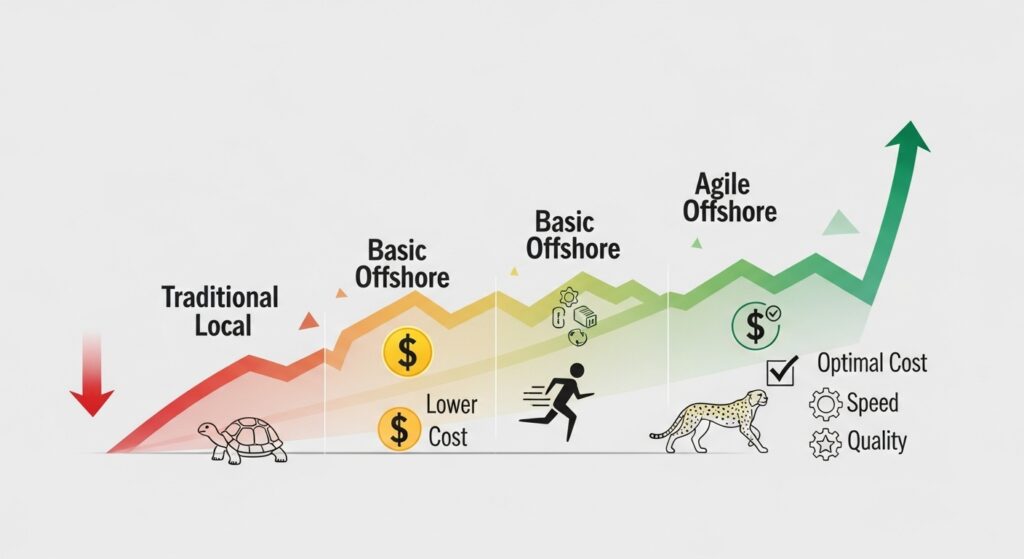
- Cost Effectiveness
Cost effectiveness and efficiency are one of the primary benefits of agile software development. As compared to Western countries, labor costs in Eastern European nations, the Philippines, and India are relatively lower. Choosing an offshore dev team from these areas benefits companies in the following ways:
- Reduce the overall cost of software development
- Invest the budget in other, more complex projects
- Allocate resources to more critical business areas
- Achieve higher ROI (return on investment) against software development projects
- Concentration on Core Business Functions
When companies outsource their software development projects, their internal resources have spare time to concentrate and stay focused on core areas of the business. The shift of this focus helps them by:
- Focusing on strategic planning that promotes business growth
- Enhancing efficiency in core operations
- Improving customer service and relationship
- Investing more resources and time in product idea creation and market analysis
- Quicker Time-to-Market
Offshore teams make a continuous software development cycle possible, irrespective of the time zones. This results in quicker progress of the software development projects, followed by:
- Faster launches and updates of the products
- Quicker delivery of new applications to the market
- More flexibility and adaptability towards changes in the market and customer demands
- Faster innovative cycles to gain a competitive edge
- Accessibility to Global Talent
With an offshore dev team, companies can access a huge pool of skilled professionals all across the world. This way, they can:
- Acquire dedicated expertise that is expensive or limited in the local market
- Form diverse teams having a broad range of experiences and skills
- Overcome technology-based and framework-based shortages in the local talent
- Utilize a wide range of the latest technical skills without needing detailed training within the organization
- Stronger Technical Expertise
Going with agile offshore development means welcoming specialized technologies with the latest development methodologies and frameworks, allowing businesses to:
- Approach dedicated resources skilled in emerging technologies, including blockchain, AI/ML, and IoT
- Keep themselves updated about the best development practices and the latest trends
- Enhance the overall sophistication and quality of the apps
- Facilitation in Team Collaboration
With offshore software development teams, companies can create a culture of team collaboration that improves the overall product development cycle. This is done by Scrum offshore development, where companies encourage unity among the team members, improving motivation and reducing turnover, through:
- An extension of the internal team that does not act as a disconnected third party
- Clear communication, shared goals, and productive feedback
- Sprint reviews and standups to make everyone feel heard
- Empowerment of team members to provide input, contribute ideas, and raise problems
- Scalability
With agile development strategies, businesses can easily scale up or down the scope based on the requirements of the project. This is specifically favorable for growing businesses and startups, helping them in these ways:
- Quick Adjustment in team size without making long-term commitments
- manage peak hours and workloads without excessive hiring
- Flexibility towards changing market dynamics
- Risk-free experimentation with new technologies and projects
- Management of Risk
Last but not least, outsourcing software development projects to offshore teams helps businesses mitigate multiple risks by providing:
- A protection to prevent the effect of local instability and talent shortages on the development cycle
- A reduction in dependency on a single location or development team
- An increase in capabilities to recover from a disaster and continue business
- A spread of economic risk
Offshore Development Best Practices
In this section, let’s have a look at the following offshore development best practices for the successful delivery of software development projects.
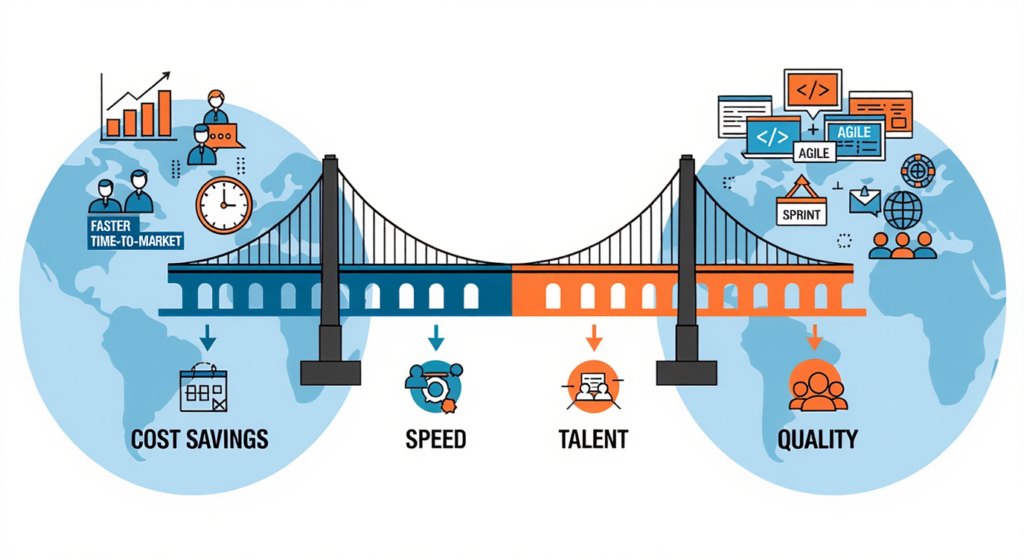
- Plan Pre-requisites and Metrics
Before you begin the offshore development projects, ensure that all the project requirements are clearly communicated to all team members. Similarly, clearly define how you would measure the success of your development projects and track outcomes: cost, efficiency, quality, and customer satisfaction.
- Promote Consistent and Open Communication
You have heard it multiple times: Communication is the key. It is not something you implement once and forget about later. Keeping offshore development team members in the loop while they work independently is a necessity, not a choice. This is why you need to develop a strong communication framework facilitated by:
- Project management tools like Jira
- Web-conferencing and video-conferencing tools like Zoom, Teams, Skype, and Slack
- Emails to communicate commitments, documents, and schedules
- Ensure Commitment to the Organization
To ensure that you and your offshore dev team are committed to the organization, ask these questions:
- How much is your organization and its individual contributors dedicated to managing and supporting offshore software development?
- How do you measure the commitment of your team members towards the organization?
Commitment to the organization is closely related to how much employees are involved and associated with it, and vice versa. As it goes both ways, you need to commit to your offshore development team, and at the same time, the team needs to commit to your organization.
- Endorse Teamwork
While working with agile development teams, you need to ensure that all team members are integrated and producing high-quality output. All of them must have a shared goal, and they are held responsible against that goal. By doing so, you must:
- Have a clear understanding of your team
- Create a healthy and long-term relationship with team members
- Ensure that there is no division and that each team member is working as one
- Continuously implement coordination and integration
- Create a Balance
While creating the balance among team members, you need to structure the whole team correctly. But how to ensure the right combination? Go back and look at how you created offshoring strategies. Consider both the organizational structure and operational risks. The vulnerability of businesses increases with the risks. If you see there is a need for more support and functions for the offshore team, you need to analyze the on-site team’s capacity and keep the balance in place.
Conclusion
Agile offshore development is not just about a cost-saving strategy. It helps businesses provide innovative solutions quickly, get access to global talent, and remain ahead in the competition. When you combine agile methods with offshore teams, you achieve flexibility, speed, and scalability while keeping the quality in place.
Even so, if you want to achieve success in the long run, you need to follow the best practices for offshore development. When you implement these practices, you convert all your offshore team members into partners and an extension of your business. As a result, your business enjoys continuous innovation, lasting relationships, and eventually success.
Don't hire us right away
talk to our experts first,
Share your challenges, & then decide if we're the right fit for you! Talk to Us
Partnerships & Recognition
Commitment to excellence




-
Location
-
 United States
-
 Dubai
Dubai
-
 Pakistan
-
-
Contact us
+1 858 355 9680 511 East John Carpenter Fwy, Suite 500
IRVING, TX 75062, USAFor Business Inquiries:
sales@nextbridge.comFor Job Applications:
careers@nextbridge.com+971-558027173 208, Building A4, Digital Park
Silicon Oasis, Dubai, UAEFor Business Inquiries:
sales@nextbridge.comFor Job Applications:
careers@nextbridge.com042-35315043 / 46 427/428 G-IV Block,
M.A. Johar Town, LahoreFor Business Inquiries:
sales@nextbridge.comFor Job Applications:
careers@nextbridge.com
United States
+1 858 355 9680
511 East John Carpenter Fwy, Suite 500
IRVING, TX 75062, USA
IRVING, TX 75062, USA
For Business Inquiries:
sales@nextbridge.comFor Job Applications:
careers@nextbridge.com
Dubai
+971-558027173
208, Building A4, Digital Park
Silicon Oasis, Dubai, UAE
Silicon Oasis, Dubai, UAE
For Business Inquiries:
sales@nextbridge.comFor Job Applications:
careers@nextbridge.com
Pakistan
042-35315043 / 46
427/428 G-IV Block,
M.A. Johar Town, Lahore
M.A. Johar Town, Lahore
For Business Inquiries:
sales@nextbridge.comFor Job Applications:
careers@nextbridge.com